


Cryptogram · Cryptoquote Game
4.53.71K Reviews
App Specs
- Version
- 1.90
- Updated On
- License
- Free
- Downloads
- 500,000+
- Developer
- Razzle Puzzles
- Categories
- Word
- Platform
- Android
Screenshots
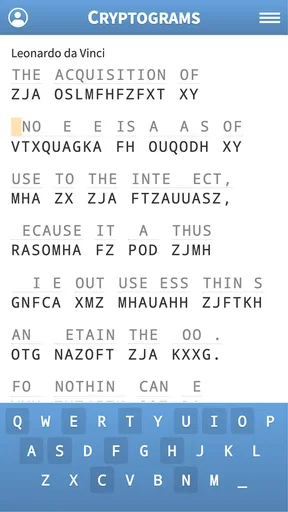
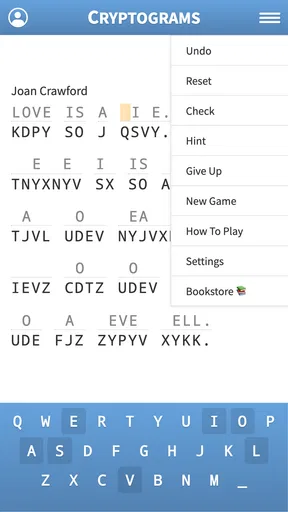
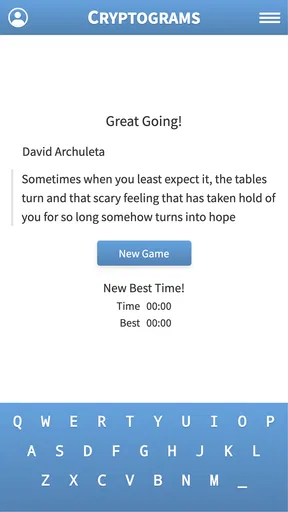
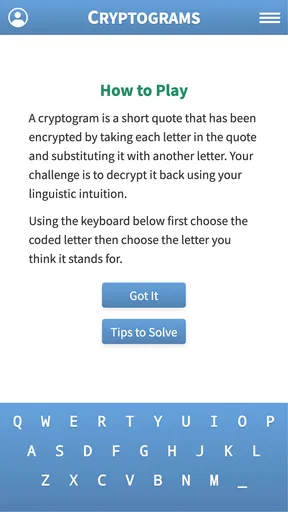
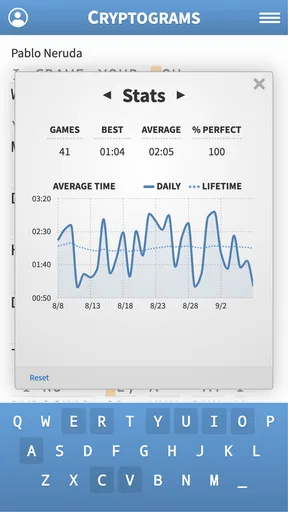
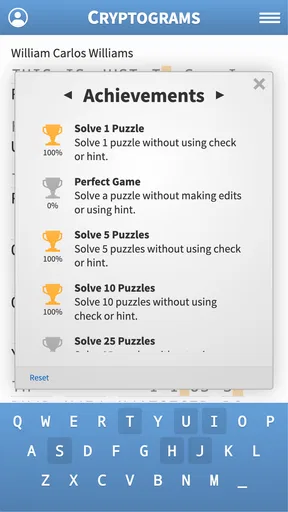
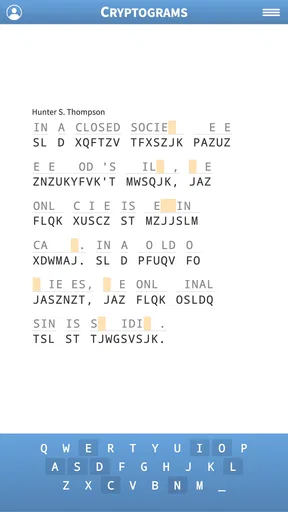
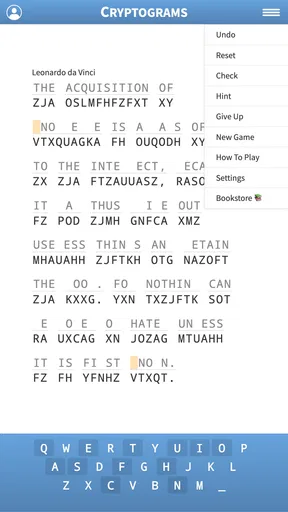
 Analysis by AppCompare
I enjoy word games that make me think without demanding a long session, and Cryptogram · Cryptoquote Game fits that mood well. It is a free word puzzle from Razzle Puzzles built around decoding quotations: each letter in a displayed message has been replaced by another letter, and I work out the substitution until the sentence becomes readable. The idea is simple, but a difficult quote can keep me occupied much longer than its quiet presentation suggests.
What makes this game appealing is the balance between language knowledge and deduction. I am not merely searching for words that fit a clue. I am testing letter patterns, spotting repeated words, and gradually building a map between the coded alphabet and ordinary English. That gives each solved quotation a small sense of discovery. At the same time, the format is approachable enough for casual play, which helps explain why the game remains a recognizable choice in the word puzzle category.
How the current version feels in everyday play
On Android, the game is listed as version 1.90 and requires Android 6.0 or later. It has been available since August 14, 2014, so this is not a new experiment trying to prove that cryptograms belong on a phone. It is an established, focused game that has had time to settle into its purpose. I appreciate that clarity: when I open it, I know I am coming for a quotation-solving session rather than a collection of unrelated distractions.
The basic loop is easy to understand. A quotation appears in encrypted form, and I tap or select letters while trying to reconstruct the original sentence. Early progress often comes from short words, repeated word shapes, and common combinations. Once I identify one likely substitution, I can apply that discovery elsewhere in the quotation and see whether the sentence starts to make grammatical sense.
That last part is important. A cryptogram is not solved by vocabulary alone. The sentence itself becomes a set of checks. If one guess creates an impossible word or makes several other words look wrong, I know I need to reconsider it. I find this more satisfying than a standard anagram because every answer has to work across the whole quotation.
A realistic use case is a short break when I do not want to start a large game. I can open a puzzle while waiting for an appointment, solve a few letters, lock my phone, and return later with the pattern still in mind. It also suits a quiet evening when I want something more active than scrolling but less intense than a timed arcade game. The absence of complicated controls makes it comfortable for one-handed, low-pressure play.
The game is free and carries an Everyone content rating, so it is suitable for a broad audience. That does not mean every quotation will be equally accessible. Someone who enjoys language, sayings, and the structure of sentences will probably get more from it than someone who wants visual spectacle or rapid rewards. The appeal is in the gradual click when a coded line finally becomes a meaningful thought.
Worth Reading Before You Choose

EA SPORTS FC Mobile 26 Is a Bigger Football Game, but It Takes Time

Flipboard Shows What News Apps Must Do Beyond the Feed

Switching to Android Auto Means Rethinking Your Driving Routine

Google Calendar Makes a Crowded Week Easier to Manage

Ludo King Makes the Most of the Minutes Between Plans

Baby Panda World Brings Quick Play to Modern Phones, but Its Game Library Feels Busy
The solving method that works best
I recommend resisting the temptation to guess a long word immediately. I start with the shortest repeated words, then look for a coded letter that appears often in several positions. A repeated three-letter pattern may reveal a common word, while a word with the same first and last coded symbols can suggest a familiar structure. These are not guaranteed answers, but they create useful hypotheses without committing me too early.
Another effective habit is to keep the quotation’s grammar in view. If the sentence seems to need a verb, a name, or a connecting word, that expectation can narrow the possibilities. I also revisit earlier guesses instead of treating them as permanent. One incorrect substitution can make an entire puzzle feel impossible, and clearing that mistake is often more productive than trying to force new letters around it.
The best way to use hints is as a last-mile tool, not as an automatic shortcut. When I am genuinely stuck, a small nudge can restore momentum. Using help too early, however, removes the most rewarding part of the game: recognizing that several separate clues suddenly support the same answer. Players who want a pure logic test should therefore use assistance sparingly, while newcomers can use it to learn how the patterns behave.
I also find it useful to read the whole quotation after every meaningful breakthrough. A word that looks plausible in isolation may sound unnatural in context. Reading the line as a sentence turns the puzzle into an editing exercise: I am checking spelling, grammar, rhythm, and meaning at the same time. That approach is particularly helpful when several letter substitutions seem possible.
Why its age matters without making it feel irrelevant
Razzle Puzzles has kept this release focused for years rather than chasing every trend in mobile gaming. The long availability is reassuring for someone who wants a familiar puzzle format, and the current version suggests an ongoing product rather than an abandoned installation. I would not interpret that as proof that every modern convenience is present, but it does explain the game’s straightforward character.
The audience response is also substantial: the game holds a 4.5 average from around 12 thousand ratings, with roughly 3.7 thousand written reviews and over 500 thousand installs. Those figures do not replace personal testing, but they indicate that the format has found a durable audience. I see that durability as one of its strengths. A cryptogram does not become obsolete simply because the interface is restrained.
For existing users, the current version is best understood as a continuation of a dependable puzzle experience rather than a dramatic reinvention. If you already enjoy solving coded quotations, an update that preserves the central method is likely more valuable than one that adds unrelated systems. The trade-off is that players hoping for a major visual or structural transformation may find the experience conservative.
I would also avoid judging it by the standards of large, constantly refreshed puzzle platforms. Those alternatives may offer daily challenges, several puzzle types, social competition, elaborate progression, or more obvious reward loops. Cryptogram chooses a narrower lane. That makes it easier to pick up, but it also means there is less reason to stay if you want variety every time you open a game.
Where it fits beside other word games
Compared with crosswords, this game gives me fewer independent clues and more interaction between letters. In a crossword, a difficult answer may be unlocked by solving a clue elsewhere on the grid. Here, the quotation itself is the main source of information, so progress depends on recognizing patterns and testing substitutions. I prefer the cryptogram format when I want a continuous sentence rather than a board of separate prompts.
Compared with anagrams, the experience is slower and more analytical. An anagram asks me to rearrange known letters, while this game asks me to discover what the letters represent. That makes it a better choice for players who enjoy deduction, but a worse choice for anyone who wants quick vocabulary rounds with a clear, immediate answer.
Compared with word searches, it is much less visual. There is no relaxing hunt through a grid; I have to pay attention to repetition and context. That can feel more mentally demanding, especially when the quotation uses unfamiliar wording. On the other hand, the same concentration gives the solved line more personality than a found word in a crowded letter field.
Large puzzle suites are the better option if you want one app to cover several moods. I would choose this game instead when I specifically want cryptograms and do not want menus full of modes competing for attention. Its specialization is both the reason to install it and the main reason some players will eventually move on.
Small frictions that affect the experience
The central challenge can become repetitive if I play for a long stretch. Because every puzzle uses the same fundamental substitution idea, the novelty comes from the quotation and my own progress rather than from changing mechanics. Short sessions work better for me than marathon play. After several consecutive puzzles, I may switch to a crossword or another type of word game simply to exercise a different kind of attention.
Difficulty can also feel uneven from one quotation to the next. A familiar phrase may fall into place quickly, while an unfamiliar line can remain opaque even when I understand the solving method. That is not necessarily a flaw in the puzzle design, but it affects the sense of momentum. Players who dislike being stuck on a sentence may find the experience more frustrating than relaxing.
The quotation format brings another trade-off: general language ability helps, but cultural familiarity can help too. If I recognize the wording or the way a sentence is likely to finish, I gain an advantage that has little to do with pure letter deduction. Players looking for a completely neutral logic challenge should keep that in mind. The game rewards both pattern recognition and comfort with written English.
It is also not the right choice for someone seeking a strong competitive layer. I would not install it expecting the energy of a head-to-head word battle or the urgency of a timed leaderboard. Its satisfaction is private and incremental. That makes it comfortable for thoughtful play, but less compelling for friends who want to compare scores in real time.
Who should install it, and who should skip it
I recommend it to readers who like quotations, language puzzles, and the feeling of solving a problem through several small deductions. It is especially suitable for people who want a game that can be paused naturally and resumed without remembering a complicated control scheme. It can also be a gentle way to develop attention to spelling patterns, word length, and sentence structure, although I would treat that as a side benefit rather than a formal learning program.
I would be more cautious if your ideal mobile game depends on constant novelty, animation, or a clear progression system. This is a specialized word game, not an all-purpose entertainment app. Players who become bored when the same mechanic returns repeatedly should try a broader puzzle collection instead. Likewise, anyone who dislikes quotations or prefers visual puzzles may not connect with its text-heavy format.
For a family setting, the Everyone rating makes it broadly approachable, but the actual enjoyment will depend on reading ability and patience. Younger players may need help understanding the substitution idea or the wording of a quotation. Adults can turn that into a cooperative activity by solving the first few letters together, then letting the child identify repeated patterns. The game works better as a calm shared puzzle than as a noisy group competition.
What I would watch in future updates
Because the current release is already mature, I would watch for improvements that protect its simplicity while reducing friction. Better ways to recover from an incorrect guess, clearer feedback when a substitution conflicts with earlier work, and thoughtful difficulty organization would all help without changing the identity of the game. I would prefer those refinements to a crowded set of unrelated modes.
I would also value careful attention to the quotation experience. A good cryptogram depends on readable text, sensible spacing, and a sentence that offers enough internal clues to reward persistence. Anything that makes the encoded line easier to scan on a phone would have a direct effect on solving comfort. The important point is not adding noise, but making the existing deduction loop feel fair.
For someone deciding whether to try it now, the practical answer is simple. It is free, widely used, and compatible with older Android devices from Android 6.0 onward. I would start with a few short sessions rather than judging it after one difficult quotation. If the act of building a letter map feels satisfying, the focused design will probably work in your favor. If it feels like slow guessing, no amount of extra time will turn it into an action game.
My overall impression is that Cryptogram · Cryptoquote Game succeeds because it understands its own scale. It does not need elaborate systems to make a coded sentence engaging. The strongest moments come from careful observation, a well-timed correction, and the instant when a string of substitutions becomes a complete thought.
After spending time with it, I see Cryptogram · Cryptoquote Game as a dependable choice for focused wordplay rather than a universal recommendation. Razzle Puzzles has kept the concept accessible and recognizable, while the current version preserves the quiet, deduction-first experience that defines it. I would recommend it to anyone who enjoys solving language patterns in small, repeatable sessions, but I would point variety-seekers toward a broader puzzle app. For the right player, this modest format has plenty of staying power.
Pros
- Relaxing gameplay suitable for short or extended sessions.
- Hints help players progress when a puzzle becomes difficult.
- Large puzzle library provides plenty of content to explore.
- Improves pattern recognition and vocabulary over time.
- Clean interface makes the game easy to learn and navigate.
Cons
- Some advanced puzzles may feel frustrating without using hints.
- Repeated quote themes can make the experience feel predictable.
- Hints and extra features may be limited by in-app purchases.
- Requires strong English skills to solve many of the quotes.
- Ads may interrupt gameplay
- especially between completed puzzles.
FAQs for Cryptogram · Cryptoquote Game
What is Cryptogram · Cryptoquote Game?
Cryptogram · Cryptoquote Game is a word puzzle app based on classic cryptograms, where famous quotations are written in code and you must decode them by replacing symbols or letters with the correct characters. As you solve puzzles, you gradually reveal meaningful quotes from different subjects and authors. It is designed for players who enjoy vocabulary, logic, and relaxed brain-training challenges.
How does the gameplay work?
Each puzzle presents an encrypted quotation in which every letter has been substituted according to a simple code. You tap or select letters to make educated guesses, using repeated patterns, word lengths, and familiar phrases as clues. Correct answers gradually uncover the quote, while mistakes can usually be corrected easily. The difficulty may increase as you progress through additional puzzle collections.
Is Cryptogram · Cryptoquote Game suitable for beginners?
Yes, the game is generally accessible to beginners, especially if you are familiar with word games or crossword puzzles. Early cryptograms often provide recognizable words and quotations that help you understand the decoding system. Even when a puzzle feels difficult, the letter patterns offer useful clues. Players who prefer a slower, thoughtful experience may find it more comfortable than fast-paced games.
Does the game require an internet connection?
The basic puzzle experience may be available without a constant internet connection, which can make Cryptogram · Cryptoquote Game convenient for travel, commuting, or offline play. However, certain features can depend on connectivity, including advertisements, optional purchases, analytics, updates, or newly downloaded content. Availability may vary by device and version, so it is worth checking the app’s current store description.
Is Cryptogram · Cryptoquote Game free to download?
The app can typically be downloaded for free, but free access may include advertising, optional hints, or in-app purchases. Depending on the version, some features or content may be limited unless you watch an advertisement or make a purchase. Before downloading, review the Google Play Store or App Store listing for current pricing, subscription details, privacy information, and any restrictions that could affect your experience.


